Course Syllabus
QSCI 381 – Introduction to Probability and Statistics
General information
InstructorsSteven Roberts (Instructor): Professor in the School of Aquatic and Fishery Sciences. Contact using Canvas Messaging (Inbox) Kathleen Durkin (TA): School of Aquatic and Fishery Sciences Contact using Ed Discussion Clare Knife (TA): School of Marine and Environmental Affairs Contact using Ed Discussion |
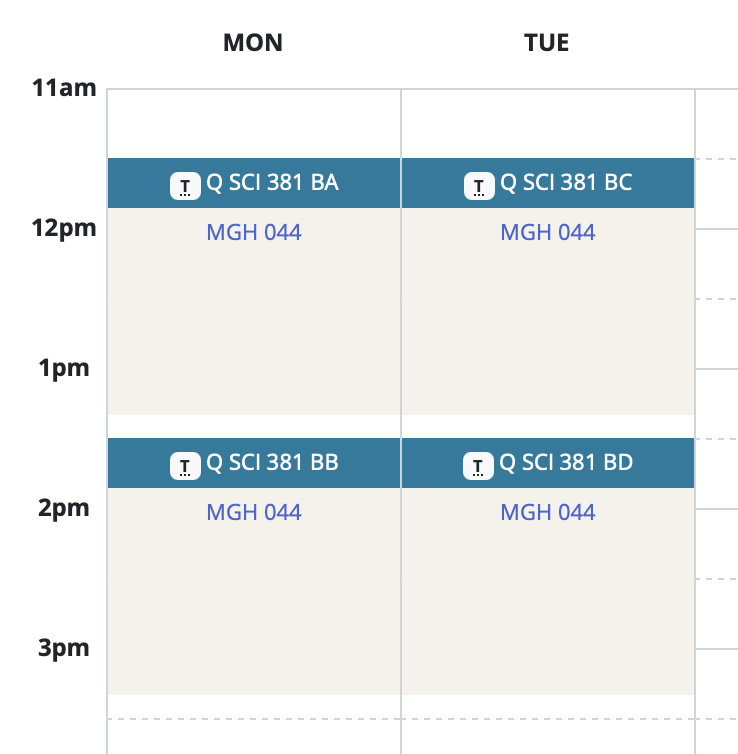
Lab Sections
|
Objective
The objective of this course is to provide students with an introductory understanding of the concept of probability and statistics. Statistics plays an important role in nearly all aspects of society, and your ability to understand, interpret, and critique data and the statistics used to analyze these data will provide you with an important foundation, regardless of your career choice. After completing this course you will:
- Understand the different types of data and how they are collected.
- Understand the basis of distributions and the information that can be inferred from them.
- Understand different types of basic data analysis, and how to interpret the results.
Teaching
Modules
Course material is split into modules (usually each module corresponds to a weeks content), with each module focused on a specific topic. On the canvas Module tab you will see these modules, and they will become available at the start of the week when that material is due to be covered. Modules consist of
- An introductory page, outlining learning objectives for that module
- Short recordings (5-10 mins) covering major topics
- Canvas pages covering that modules material
- Links/access to additional learning resources such as interactive apps and videos
- Link to RStudio Lab where Skills Development and Homework Assignments are accessible.
Modules are structured to walk you through materials covered that week, and module content will be evaluated via weekly quizzes (see below).
Short recordings
The core course materials will be delivered via short video recordings of key concepts that are to be viewed prior to working on the Skill Development Labs or Homework Assignments. These recordings will provide an introduction to topics in probability and statistics, and gives the necessary background information for participating in problem solving during weekly labs and assignments.
Canvas Content
In addition to short recordings, we will elaborate on concepts introduced via Canvas pages. Near the end of each module's Canvas content is a "Summary & Application" page where you can work through the steps to solving a problem similar to the Skill Development Lab, and Homework Assignment for that module.
Video recordings and Canvas content are designed to correspond to material covered in the course textbook. You may choose to do the textbook readings first, and then work through the recordings and Canvas content; or you may opt to review the material in Canvas first, and do the textbook readings as a form of summary.
Skill Development Labs
There are in-person lab sections associated with this course (attendance is not required.) Time in lab is designed to assist in applying concepts from the course using RStudio as a platform. Specifically for this course we will be using UW JupyterHub instances of RStudio accessible at https://jupyter.rttl.uw.edu/2026-winter-q-sci-381-b/user-redirect/rstudio. During Lab there will be a focus on Skill Development problems that are consistent with homework assignment topics. The skill development problem sets (and Homework assignments will be available on Course JupyterHub RStudio in the COURSE MATERIALS directory. The lab sections will also serve as a form of traditional "Office Hours" for questions about content and logistics.
Homework assignments (Individual work)
Homework assignments build on skills, giving you additional opportunities to apply the concepts learned during the week, and advance your understanding of the material. Assignments consist of a series of questions, typically regarding the manipulation and processing of specific datasets, highlighting techniques introduced in Canvas content. Homework assignments will be available on Course JupyterHub RStudio in the COURSE MATERIALS directory. Homework assignments will be turned in using GradeScope.
Assessment
Grades are based on
- Weekly Quizzes (including Summary Sheets) (35%) - Due Friday
- Weekly Homework assignments (15%) - Due Tuesday of following week
- Mid-term exams (2) (30%) - In Lab, Dates below (In-Person)
- Final exam (20%) - March 18 (In-Person)
Grades are calculated as an average % and then converted to a grade scale
≥ 97% = 4.0
93–96% = 3.7–3.9
90–92% = 3.5–3.6
87–89% = 3.3–3.4
83–86% = 3.0–3.2
80–82% = 2.7–2.9
77–79% = 2.5–2.6
73–76% = 2.0–2.4
70–72% = 1.7–1.9
67–69% = 1.3–1.6
63–66% = 1.0–1.2
< 63% = 0.0
Quizzes (including Summary Sheets)
Quizzes are a required part of the course as they make up 35% of the grade. Quizzes consist of a series of multiple choice questions designed to assess your understanding of the core concepts covered the previous week. The majority of quiz questions will require minimal/no calculation, but some will require simple calculations following steps outlined during lectures and/or labs. Quizzes will be completed on canvas in your own time, but must be completed by the quiz deadline (all missed quizzes will count as a zero score). There will be a time limit on each quiz (15-20 minutes), and once you have started the quiz you will need to answer all questions before the allotted time is up. Once an answer has been submitted for a question you cannot go back to that question, so please answer each question carefully, making sure you read and understand all options before selecting an answer. NOTE that summary sheets are to be uploaded as part of the Canvas Quiz - thus it is essential you have your Summary Sheet complete before starting the quiz.
Summary Sheet
For each quiz, students must submit a summary sheet prepared in advance. A summary sheet is a single handwritten page (maximum one page, front only) of student-created notes that synthesizes the key concepts, definitions, figures, equations, and examples from the assigned readings and overall module content. The sheet may be written on paper or created digitally using a tablet and stylus, but it must reflect handwritten note-taking rather than typed text.
The purpose of the summary sheet is to promote active learning by requiring students to distill, organize, and connect ideas in their own words, rather than copying definitions or transcribing slides. Simply listing vocabulary or pasting textbook wording does not meet this expectation. Summary sheets must be original work, clearly legible, and demonstrate the student’s own interpretation and prioritization of the material.
Summary Sheet Rubric (5 points total)
| Criterion | Full Credit | Partial Credit | Minimal / No Credit | Points |
|---|---|---|---|---|
| Content Coverage | Includes major concepts from readings, Canvas, and associated R code | Some key concepts included but important topics missing | Little connection to Module content | 0–2 |
| Synthesis & Understanding | Clearly synthesized in the student’s own words; shows understanding rather than copying | Some synthesis but mostly copied or listed without connections | Largely copied or unclear | 0–1 |
| Organization & Clarity | Well organized, easy to follow, logical structure | Some organization but cluttered or hard to follow | Disorganized or difficult to read | 0–1 |
| Preparation & Format | Single page (front only), clearly legible, prepared in advance | Minor formatting or legibility issues | Exceeds page limit or illegible | 0–1 |
Total: 5 points
Notes
- Summary sheets are graded for effort and understanding, not artistic quality.
- Bullet points, diagrams, equations, and annotated figures are encouraged.
- Summary sheets should be original work and reflect the student’s own interpretation of course material.
Mid-terms
There will be two IN PERSON 90 minute mid-term exams that will take place.
Mid-term 1: IN LAB SECTION WEEK OF FEBRUARY 2 (encapsulating materials covered in Modules 1 – 3)
Mid-term 2: IN LAB SECTION WEEK OF FEBRUARY 23 (encapsulating materials covered in Modules 4 – 6)
The first mid-term will test the basic concepts of statistics and probability. However, there will be questions on probability that will require calculations, so you should know how to perform basic probability/statistics calculations either in RStudio, or using a calculator. The second mid-term will likely involve a larger proportion of calculation questions, and may consist of a mix of questions on core concepts as well as your ability to run statistical analyses using RStudio..
Final exam
IN PERSON
March 18 Wednesday 1:00-4:00PM MLR 301
There is also an alternative testing time on Monday, March 16, 2-5PM in FSH 136 if you have a conflict.
The final exam will be comprehensive, but focus should be placed on the latter half of the course content as the first half will have been evaluated during the course mid-terms. As with the mid-terms, the final exam will take place via canvas within a certain time-limit. Again, please note that the timing of the exams is strict and you will need to know the material in order to complete the exam on time.
Extensions, late assignments & missed exams
Extensions on class assignments (quizzes and homework) can be requested and will only be granted if: 1) you have notified your TA and the instructor at least 48 hours in advance of the due date, and 2) you have a legitimate reason(s) for requesting the extension (defined below). We have full discretion over whether to grant an extension; do not expect extensions will be granted in all cases. Note that extensions are not in effect unless you have received a Canvas Message from one of the instructors saying you have in fact been granted an extension and a new due date has been established.
Late assignments are penalized by 15% if they are less than a day late (unless prior arrangements have been made – see above), such that if an assignment is submitted up to 1-day late it will have a max score of 85%. Assignments more than a day late will not be accepted. We will strive to grade all assignments within 1 week of the due date.
Taking the final is a requirement to pass the course. If you miss the final exam the exam grade will go down as a zero and you will be assigned an incomplete for the course. You must arrange with the instructor to take the final at the soonest possible opportunity to have your grade changed.
Legitimate reasons to miss an exam or request an extension include, for example, University-sanctioned academic or athletic activities, Military service obligations, illness or injury requiring medical attention, family emergencies requiring off-campus travel, or similar. Documentation includes, for example, a note from the attending physician, travel documents, etc. Instructors must be notified of the qualifying emergency exception event within 24 hours of the exam date/time.
Course Tips
Spend four hours per day reading, watching lectures, completing quizzes and working through assignments. Also, stay on top of deadlines to make sure that you don't get bogged down, particularly towards the end of the course. Utilize the discussion features when working on assignments - if you have a question, it is likely that others will too and the answer you are looking for may already be posted.
When you need clarification on course logistics, deadlines, and/or the format of assignments, midterms, or finals, chances are that others have the same question. First look for the answer in Ed Discussion > General, and if you don't see an answer do everyone a favor and ask the question. The instructional team will try to address it as soon as possible.
Plagiarism and course content
Do not share any course materials (lectures, lecture notes, recordings, assignments, quizzes, exams) posted to the class Canvas site. These materials are protected by U.S. copyright law and by University policy and may not be reproduced, distributed, displayed, posted or uploaded without written permission from the instructor. If you do so, you may be subject to academic misconduct proceedings under the UW Student Conduct Code.
Use of Agentic AI Tools
Agentic AI tools (such as ChatGPT, GitHub Copilot, or similar systems that generate text or code) are widely available and increasingly common. In this course, these tools may be used as a study aid—for example, to help explain concepts, interpret error messages, explore alternative approaches to R code, or debug syntax—in the same way you might consult online documentation or discussion forums.
However, you may not submit AI-generated work as your own. Any assignment, exam, code, or written work that you submit must reflect your own understanding and effort. Passing off AI-generated output (including R code, interpretations of results, or written explanations) as original work constitutes academic misconduct and may be subject to academic misconduct proceedings under the UW Student Conduct Code.
Course Summary:
| Date | Details | Due |
|---|---|---|